

Brazil is a country with the largest black population outside of the African continent. However it has often been the subject of dialogue regarding the strenuous challenges many of it’s black citizens face on a daily basis. When it comes to natural hair, the attitudes toward it are strained. Just this past week, we covered the backlash, talented Afro-Brazilian actress Taís Araújo received after revealing her natural hair.
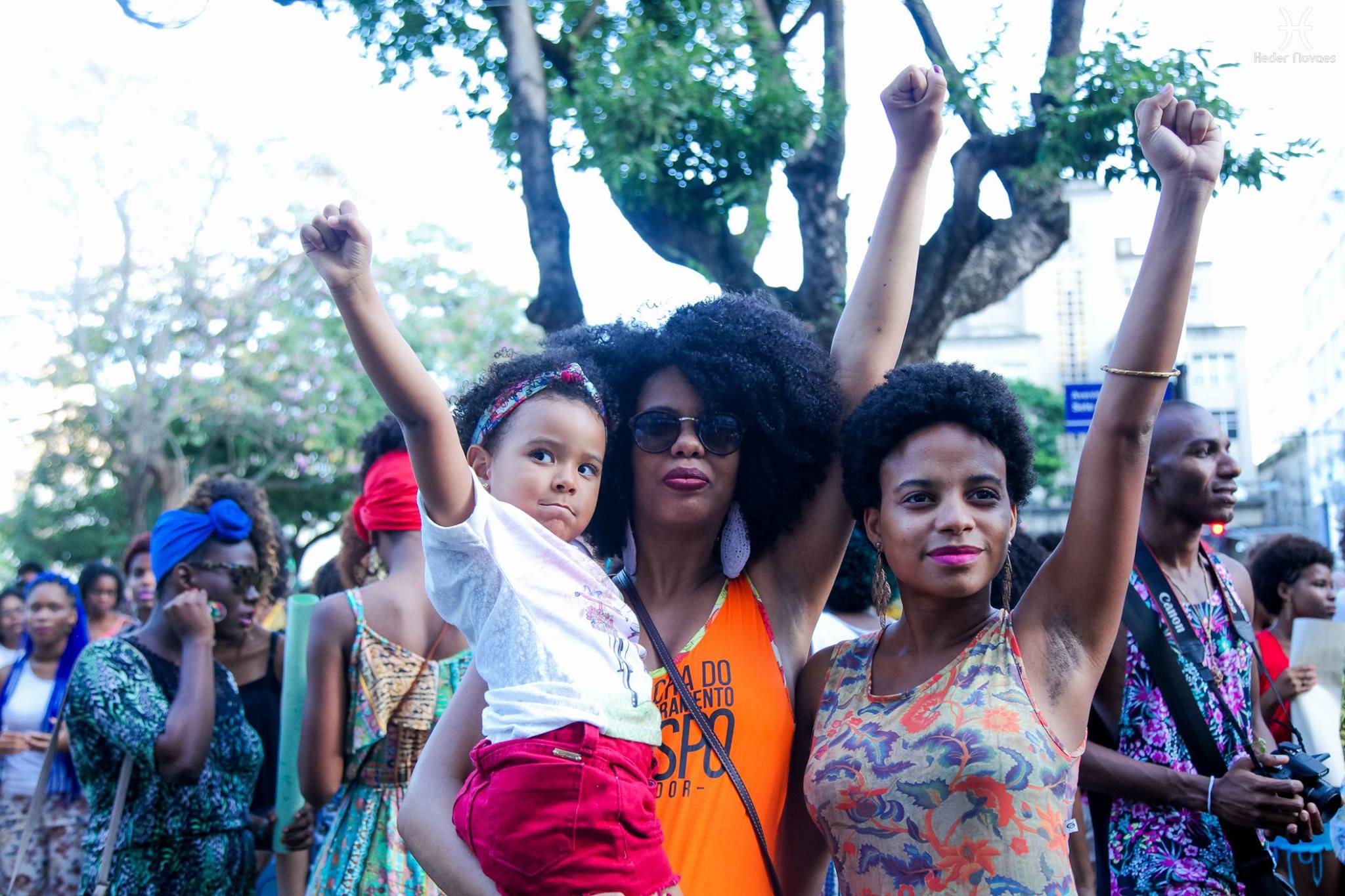
Now the Afro-Brazilian community has decided to embark upon change with their first ever Natural Hair Empowerment March also known as “Marcha do Empoderamento Crespo.” The March took place last Saturday, November 7 in S lvador. This was exactly 41 years after the historic first march that marked the start of the Black Power movement in Ba’hia in 1974.
Organizers Lorena Lacerda, Andrea and Naiara Souza Gouveia say the idea from the march was launched from their Curled and Curled Facebook group and the need for such an event is clear:
“Women suffer from both sides. Racism and sexism. Therefore, we use the concept of empowerment. From the aesthetics, the woman empowers and empowers the community” [translated]
Another organizer, Naira Gomes also chimed in:
“So good to say, aesthetic for us is political. The hair is a symbol, a pretext to fight against racism.” [translated]


Have you seen any other marches for Natural hair internationally?


45 Responses
WOW! All the more power to them!!!
What they are doing is very good. This whole thing of putting artificial hair like black Americans is nonsensical. You will never see a white woman who puts a black wig on her head. This has a lot to do with doubting your real identity and adopting fake practices they do not define you. What seems to amaze us is that this has been adopted by African woman who have taken it a step further by using skin lightening creams. Way to go for them in embracing their true identity. I’m waiting for the South African edition of this then the Detroit , New York, Chicago , Nigerian , Angolan etc edition of this.
and when are they going to visit home in Mozambique, Africa lol
That is so awesome…so awesome that we are having our first Natural Hair Empowerment March on August 20, 2016 in Detroit!!!! Can’t wait to make history with these event!!!!!
Events like this are very inspiring to me.
Where can I find that black attitude shirt. I LOVE it!
Some of this images are not from this march, are from another “marcha do orgulho crespo” in São Paulo!
OMG this is beautiful..The Diaspora is awakening. Ladies carry the torch and must lead the nations out of darkness.
Love it!! more men was here than in other movements like in US : open-minded
I love the array of natural hair styles on all ages, from cute black girls, to young adult and older black women. I can feel the aura of cultural unity, and those smiles lighting up their faces show how content these women feel at the freedom to be true to themselves in this environment that’s free of judgment and rich with culture. Beautiful. This feels inspiring to me as a black woman.
These are so yummy. I love the curls, the colours and the attitude.
Genuine question though: if this is what most people from Brazil look like, whose hair is that being marketed as “brazillian weave”?
Actually Brazil is a rainbow nation. Salvador is our blackest metropolitan area.
Brazil isn’t half black, it’s half “white” (with 1-10% of people being white by U.S. and European standards, but >25% being white by Mexican, Cuban, Chilean and Argentine standards) and half visibly racialized. We have a lot of regional variation. For example, Santa Catarina was 94% white in our 1940 census, when the entire country was around 65% white. We’re the post-2060 United States, but with a lot more of race-mixing.
Pardo is not synonymous with lightskin black people but rather brown-complexioned non-Indigenous people of all kinds, including people of Indigenous, Middle Eastern and South Asian ancestry (including some of our near 1 million Romani people, or ciganos, the second biggest Romani population in the world after the U.S.). Some of it is due to the stigma of being black, but most of it is due to acknowledging privilege when it comes to colorism or really not being obviously Afro-Brazilian at all.
People who identify on censuses as negro, which is the identity our Black movement campaigns for (they bash the adoption of the term pardo by any member of the African diaspora who is visibly racialized), are solely 6-8% of the population.
By the way, I am in fact called out for identifying as nican tlaca when it’s fairly obvious that I have Indigenous South American ancestry, because in a Brazilian context I’m not a target of any interpersonal or institutionalized racism. This same Black movement is openly against people who ‘pass’ identifying as non-white, and they will police not just blackness according to these standards but also stuff that isn’t their lane (anti-Indigeneity, Orientalism, antisemitism and antiziganism).
A good article on Brazil’s colorism: https://webcache.googleusercontent.com/search?q=cache:ILh_5AKxXcoJ:africasacountry.com/2014/06/neymar-and-race-in-brazil/+&cd=1&hl=pt-BR&ct=clnk&gl=br
By the way, according to our super-variegated color palette, I am amorenado (tanny white) while my parents are morenos-claros (lightskin tan people), and my brother (who has a black mother) is a true moreno (tan person). I always pass as white in most contexts and sometimes pass as brown in rich neighborhoods and in cities of heavy European settlement. My parents mostly pass as white and my brother always passes as brown.
Me and my brother possess strong Indigenous and at least 3/4 of fair-headed Portuguese ancestry through our paternal grandmother, and strong Sephardic and gentile Portuguese ancestry as well as more distant Indigenous ancestry through our paternal grandfather.
I’m not sure about Afro-Brazilians, since no one looks any partially black among our vast extended family, to the exception of the occasional curly hair among tons of Asian-like straight or wavy dark hair, but Portuguese people also have non-European admixture from surrounding peoples, Phoenicians, Carthaginians, Jews, Arab conquerors and even the maafa itself. Uneducated guess would read my father as an obvious [white Brazilian] person of African descent due to how Indigenous peoples of our region often have African-like features due to ancestral admixture with the ancestors of Papuans, Aboriginal Australians and Melanesians (see Luzia), which also exists in e.g. Japan (Jomon culture, Ainu).
I possess Azorean (3.125%), Romand Swiss (3.125-9.375%), possibly Belgian (6,25% – idk if my great-great is Swiss or Belgian), other Portuguese, darkskin Afro-Brazilian (doubtful – there’s a legend my great-great was a rape child, but it could also be her parents trying to hide non-white ancestry in a European immigrant-dominated countryside) and Kashubian Pole (6,25%) ancestry through my maternal grandmother, who raised me and through whom I inherit most of my looks and personality (including my autism; she’s also the reason why I’m 4 shades lighter and much less sun-tolerant than my parents). When she had long, wavy black hair over a blushy pale face with European-like hazel eyes as a youth (Brazilians tend to have half-moon-shaped eyes which reflect our Indigenous ancestry), she passed as a Levantine Arab girl when people tried to guess where she came from.
Finally, my maternal grandfather passed as brown as a youth and as black as an older man. He had reddish dark brown skin, curly hair, and Aboriginal Australian-like features in regards to nose and lips. His paternal grandmother was a full-bloodied Indigenous person, member of a proper nation, likely Puri or Botocudo, and his father also looked black, but had straight-haired children with his second wife (not my great-grandmother), another Indigenous person. My great-grandmother was a lightskin person of African descent, but she had European facial features. In fact, her progeny of 7 or 8 children spans all sorts of phenotypes, from black as my grandfather to a curly-haired blonde sister. 2 passed as black, 3 as brown and 3 as white.
My mother has mixed hair which is Afro-textured in her forelock but wavy in the back of the head. Otherwise she fully passes as white and a Romanian boss she had as a youth always told her she looked like the girls of his hometown (same skin color, body type and facial features).
Most Brazilians also have Indigenous and/or African bloodlines relatively whitened through European immigration, typically between 30 and 95%.
Actually Brazil is a rainbow nation. Salvador is our blackest metropolitan area.
Brazil isn’t half black, it’s half “white” (with 1-10% of people being white by U.S. and European standards, but >25% being white by Mexican, Cuban, Chilean and Argentine standards) and half visibly racialized. We have a lot of regional variation. For example, Santa Catarina was 94% white in our 1940 census, when the entire country was around 65% white. We’re the post-2060 United States, but with a lot more of race-mixing.
Pardo is not synonymous with lightskin black people but rather brown-complexioned non-Indigenous people of all kinds, including people of Indigenous, Middle Eastern and South Asian ancestry (including some of our near 1 million Romani people, or ciganos, the second biggest Romani population in the world after the U.S.). Some of it is due to the stigma of being black, but most of it is due to acknowledging privilege when it comes to colorism or really not being obviously Afro-Brazilian at all.
People who identify on censuses as n**ro, which is the identity our Black movement campaigns for (they bash the adoption of the term pardo by any member of the African diaspora who is visibly racialized), are solely 6-8% of the population.
By the way, I am in fact called out for identifying as nican tlaca when it’s fairly obvious that I have Indigenous South American ancestry, because in a Brazilian context I’m not a target of any interpersonal or institutionalized racism. This same Black movement is openly against people who ‘pass’ identifying as non-white, and they will police not just blackness according to these standards but also stuff that isn’t their lane (anti-Indigeneity, Orientalism, antisemitism and antiziganism).
Please search about the 130 colors of Brazil’s “cor de pele” palette, which spans a lot of categories based on skin color, facial features, hair texture and body type. A good analysis I found online is titled “Neymar and the Disappearing Donkey”.
By the way, according to our super-variegated color palette, I am amorenado (tanny white) while my parents are morenos-claros (lightskin tan people), and my brother (who has a black mother) is a true moreno (tan person). I always pass as white in most contexts and sometimes pass as brown in rich neighborhoods and in cities of heavy European settlement. My parents mostly pass as white and my brother always passes as brown.
Me and my brother possess strong Indigenous and at least 3/4 of fair-headed Portuguese ancestry through our paternal grandmother, and strong Sephardic and gentile Portuguese ancestry as well as more distant Indigenous ancestry through our paternal grandfather.
I’m not sure about Afro-Brazilians, since no one looks any partially black among our vast extended family, to the exception of the occasional curly hair among tons of Asian-like straight or wavy dark hair, but Portuguese people also have non-European admixture from surrounding peoples, Phoenicians, Carthaginians, Jews, Arab conquerors and even the maafa itself. Uneducated guess would read my father as an obvious [white Brazilian] person of African descent due to how Indigenous peoples of our region often have African-like features due to ancestral admixture with the ancestors of Papuans, Aboriginal Australians and Melanesians (see Luzia), which also exists in e.g. Japan (Jomon culture, Ainu).
I possess Azorean (3.125%), Romand Swiss (3.125-9.375%), possibly Belgian (6,25% – idk if my great-great is Swiss or Belgian), other Portuguese, darkskin Afro-Brazilian (doubtful – there’s a legend my great-great was a r**e child, but it could also be her parents trying to hide non-white ancestry in a European immigrant-dominated countryside) and Kashubian Pole (6,25%) ancestry through my maternal grandmother, who raised me and through whom I inherit most of my looks and personality (including my autism; she’s also the reason why I’m 4 shades lighter and much less sun-tolerant than my parents). When she had long, wavy black hair over a blushy pale face with European-like hazel eyes as a youth (Brazilians tend to have half-moon-shaped eyes which reflect our Indigenous ancestry), she passed as a Levantine Arab girl when people tried to guess where she came from.
Finally, my maternal grandfather passed as brown as a youth and as black as an older man. He had reddish dark brown skin, curly hair, and Aboriginal Australian-like features in regards to nose and lips. His paternal grandmother was a full-bloodied Indigenous person, member of a proper nation, likely Puri or Botocudo, and his father also looked black, but had straight-haired children with his second wife (not my great-grandmother), another Indigenous person. My great-grandmother was a lightskin person of African descent, but she had European facial features. In fact, her progeny of 7 or 8 children spans all sorts of phenotypes, from black as my grandfather to a curly-haired blonde sister. 2 passed as black, 3 as brown and 3 as white.
My mother has mixed hair which is Afro-textured in her forelock but wavy in the back of the head. Otherwise she fully passes as white and a Romanian boss she had as a youth always told her she looked like the girls of his hometown (same skin color, body type and facial features).
Most Brazilians also have Indigenous and/or African bloodlines relatively whitened through European immigration, typically between 30 and 95%.
This is just everything…
The best thing to do is to not label l people in the first place, saying someone is this and someone is that only serves to create division in the end..Its to good to be proud of your heritage and who you are as a people, but those labels always come back to bite us in the back.
When I see them, I see us in the USA. I kind of feel more connected to them than Blacks in other parts of the world.
This is awesome. There are people too.
Good to see the natural hair movement is going international/world wide.
ahhh….The African Diaspora is a beautiful thing.
So when are we marching here in the US? lol we need to get it together!
word!!
In my mind I thought,”Brazilians know they are black!?” But it’s very nice and heart warming to see a Natural hair movement being paraded on a international level. I thought it would only be one texture appreciated but I’ve seen afro puffs, Afros, braids, and twa’s. This is worth sharing on Google. Not to mention while I was looking at these photos, most of these ladies kind of resemble us. Blue and green definitely compliments them.
Next will be in Porto Alegre!!! November 15th. I’ll be there!
this is actually one of several such marches across the country. therewas one very big one in São Paulo this summer. some of the pictures above, such as the one from Karol Conka, are from the SP march. I was in attendance. It was a very beautiful and emotionally moving event. please see this link for local news coverage, more pics, and translations: https://thesaladbowl.kinja.com/footage-my-translation-re-the-natural-hair-pride-mar-1735971428
Love it! Now I am nursing MAJOR hair envy. Ugh!
Love it!/
This was not the first, and some of the pics you show are from the one this summer in são paulo. I was there in sp when it happened. It was a very powerful event!
How can anyone hate something so beautiful?
Am i the only white male that thinks natural hair on a black girl is.. well, awesome? I don’t get it.. I lived in Chicago and met so many girls who would hide their beauty under some shitty wig or terrible weaves. Be who you are.. you’re fucking sexy with those curly fluff locks!!! Please don’t hide it!
Sometimes wigs and weaves can be worn as a protective style, but I agree with you for the most part. Historically our natural hair has been seen as ugly or unattractive and not the standard of beauty. There’s a lot historically and psychologically to it that you might not understand.
Candytripn – Thank you for seeing and speaking to the beauty that is inherent in African kinks and coils. It’s been a long time coming for those of us who have super curly hair to stop allowing others to dictate beauty standards that ignore or ostracize what’s ours to live and deal with – hair or otherwise. It’s indigenous, it’s part of who we are, and will not and should not be bred out of/eliminated from our DNA. Having kinks and coils have inspired us to achieve high levels of creativity when it comes to hair care. Our hair provides us with the unique ability to wear our hair in a variety of styles, from kinky to straight and everything between. Our hair is awesome!
OMG..Love these photos. They look beautiful and radiate such pride and confidence. I have never wanted a blue afro until this moment. Attitude Black. I am going to research the original march.
Good for them!
I am so HAPPY to see the real Indigenous Brazilians yes yes!!!!!!!
…Indigenous Brazilians actually look similar to those from Mexico. Please don’t endorse settler colonialism through erasing us.
Check my gurls out “YOUR BEAUTIFUL N EVERY WAY!!!!!!
So much beauty in this post wow!
It was a great day….and a FIRST day….but just for Salvador. Other cities with Black communities had empowerment marches before Salvador, most notably in Minas Gerais.
I am so happy to seeing brazilian women with theirs curly hair. For us is a daily battle go out our houses to fighting against racism. In Brazil the racism is different of USA ,diferente culture, diferent people, but the pain is similar.I am grateful about your supporting.
Your turn America
So awesome! Muito obrigado!
All that beautiful hair. Love it!
OMG!!! I Looooooove this. I wish this march was global. That would be so freaking awesome to see black women marching in unison across the globe in our natural beauty.
The people in the pictures are absolutely breathtaking.
black women come in all shades. Those who say otherwise are narrow-minded for even in Africa we have very light skinned non mixed women
Cabelo Crespo baby!